
News Release
FY2026
November 20, 2026
JX Advanced Metals Corporation
JX Advanced Metals' Cadmium Zinc Telluride (CdZnTe) Substrates Selected for Infrared Detectors Used in NASA's Latest Space Telescope
JX Advanced Metals Corporation (President: Hayashi Yoichi, hereinafter "the Company") announces that its cadmium zinc telluride (CdZnTe) substrates have been selected for use in the manufacture of infrared detectors produced by Teledyne Scientific & Imaging for installation aboard the Nancy Grace Roman Space Telescope, the latest space telescope developed by the National Aeronautics and Space Administration (NASA).
Launched in August 2026, the Nancy Grace Roman Space Telescope is NASA's next-generation observatory, with primary missions focused on investigating dark energy and exploring exoplanets. Through observations aimed at uncovering the mysteries of cosmic evolution and structure formation, the telescope is expected to significantly advance humanity's understanding of the universe.
One of the telescope's core scientific instruments is a large-scale infrared detector designed to capture extremely faint infrared signals from space with exceptional accuracy. The detector is developed and supplied by Teledyne Scientific & Imaging, a global leader in spaceborne infrared detector technology. Teledyne's infrared detectors are renowned for their high sensitivity and reliability and have been utilized in numerous NASA space exploration missions.
The Company's CdZnTe substrates are used as a key material in Teledyne's infrared detectors and play an important role in supporting the Roman Space Telescope's advanced astronomical observations. The Company's substrates have also been used in the production of infrared detectors for the Hubble Space Telescope and the James Webb Space Telescope, contributing for many years to some of the world's most advanced space observation projects.
CdZnTe is a compound semiconductor material composed of cadmium (Cd), zinc (Zn), and tellurium (Te), and is widely used as an essential substrate material for high-performance infrared detectors. Observations of distant galaxies, star-forming regions, and areas surrounding black holes require the detection of extremely faint infrared light, and CdZnTe substrates provide the high performance needed for these demanding applications.
Leveraging its proprietary crystal growth and wafer processing technologies, the Company manufactures CdZnTe substrates with world-leading quality and the industry's largest substrate dimensions. The use of large-area substrates enables the fabrication of large-format detectors without joining multiple substrates together, eliminating inactive regions caused by seams between substrates. As a result, seamless, highly uniform, and high-resolution imaging can be achieved.
Because of these advantages, demand for large-area CdZnTe substrates is increasing for space telescope applications requiring both a wide field of view and high-resolution observations. The infrared detectors installed aboard NASA's latest space telescope also incorporate the Company's large-area CdZnTe substrates.
For many years, the Company has supported a wide range of advanced industries, including the aerospace and optical communications sectors, through the supply of high-quality crystalline materials produced using its advanced crystal growth and substrate manufacturing technologies. Going forward, the Company will continue to refine its proprietary technologies and contribute to the development of a sustainable society by supporting cutting-edge technological innovation around the world.
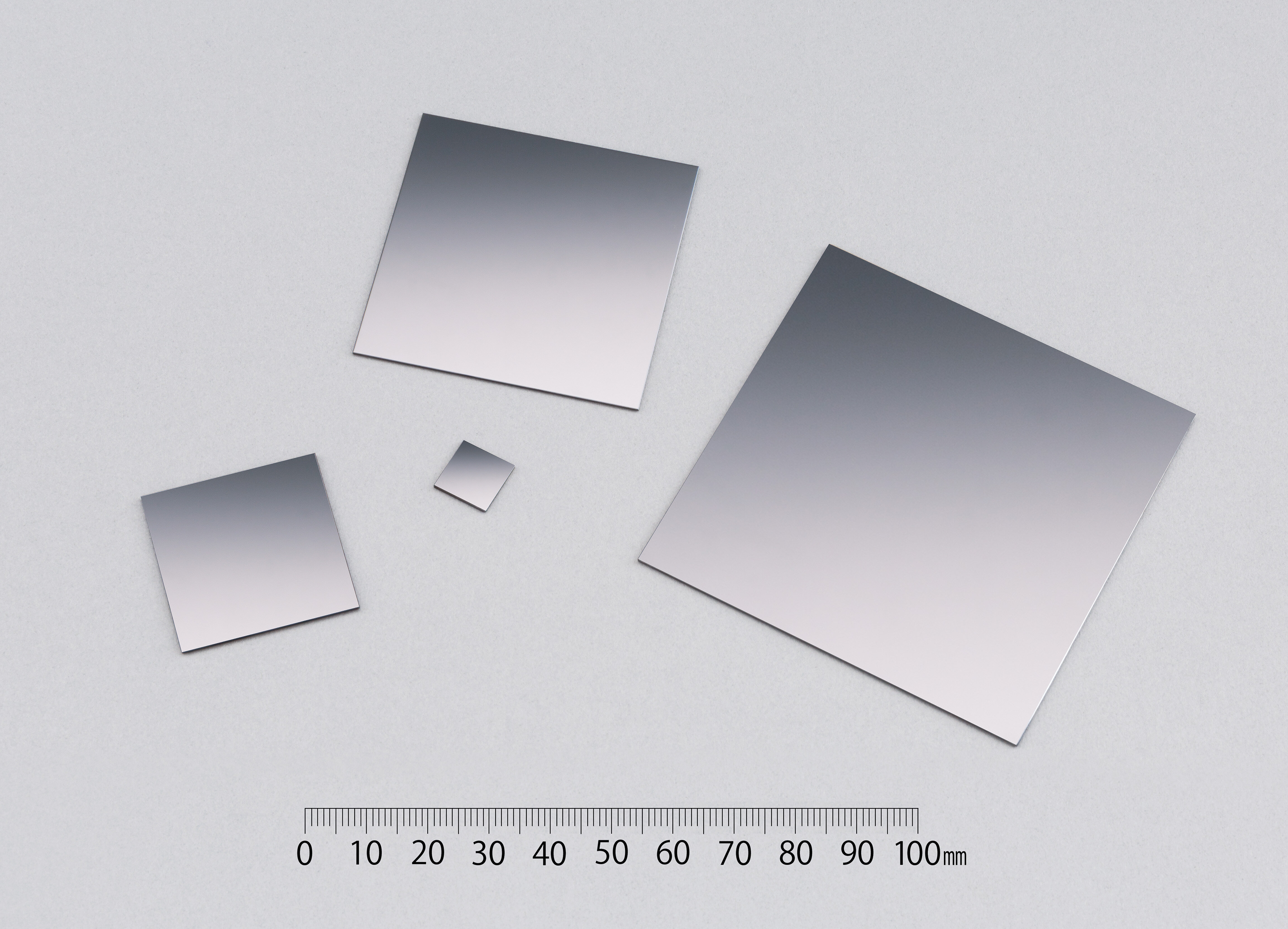
CdZnTe substrates